
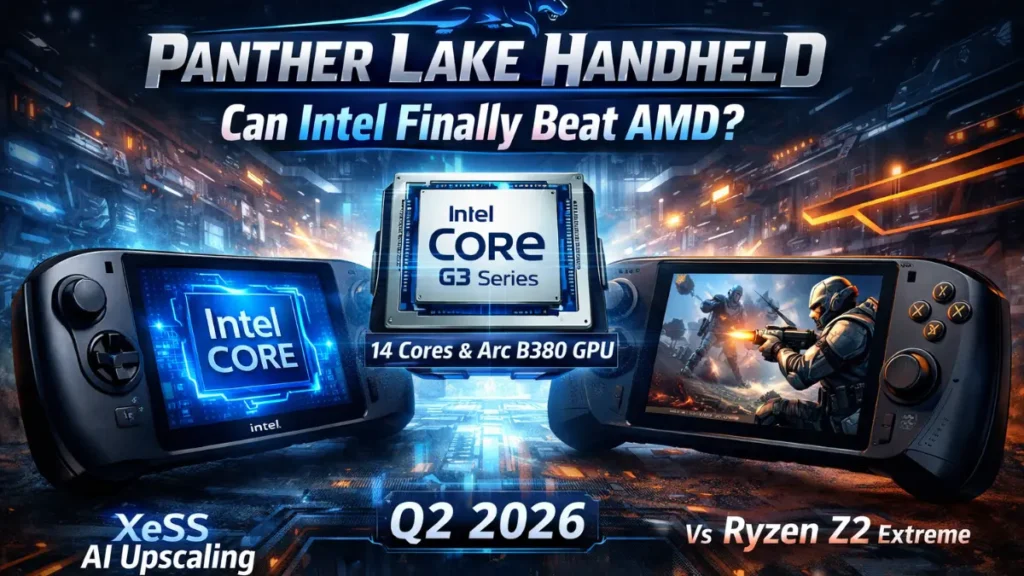
Intel is making its most serious push yet into the handheld gaming market with a dedicated Panther Lake handheld platform. After struggling to gain traction with Meteor Lake and achieving modest success with Lunar Lake, the company has announced a custom Core G3 series specifically engineered for gaming handhelds, set to launch in Q2 2026.
Core G3 Series: Technical Specifications
Intel will release two variants of its Panther Lake handheld processors, both utilizing a 14-core CPU configuration with 2 P-cores, 8 E-cores, and 4 LP-E-cores. This configuration points to true Panther Lake architecture rather than the alternative Wildcat Lake design.
The Core G3 Extreme features the Arc B380 integrated GPU with 12 Xe3 cores and a maximum CPU clock speed of 4.7 GHz. The GPU runs at 2.3 GHz, making it the flagship option for maximum performance.
The standard Core G3 comes with the Arc B360 iGPU sporting 10 Xe3 cores, with CPU clocks reaching 4.6 GHz and GPU clocks at 2.2 GHz. Both processors use LPDDR5X-8533 memory, which is slower than the LPDDR5X-9600 found in standard Panther Lake laptop chips. This appears to be a cost-saving measure given the current memory market crisis, rather than a technical limitation.
Panther Lake Handheld Performance: What to Expect
While handheld-specific benchmarks aren’t available yet, laptop versions of Panther Lake provide strong indicators of what to expect. The Arc B390 integrated GPU in Core Ultra X9 388H laptops delivers 73% higher performance than AMD’s Ryzen AI HX 370 at 1080p High settings with upscaling enabled.
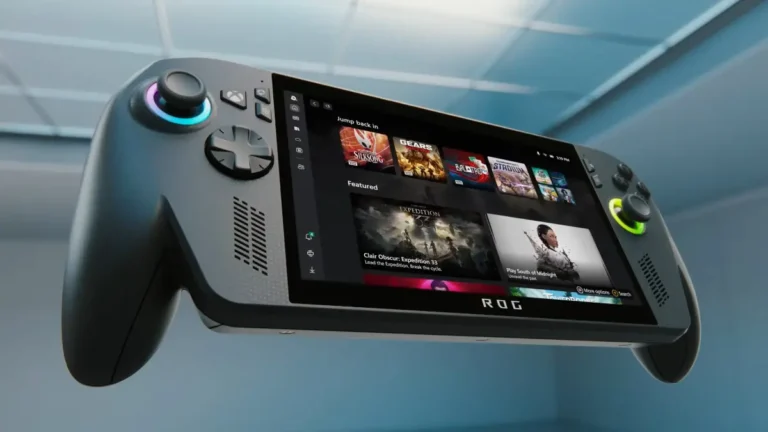
Based purely on core count (12 Xe3 cores versus 16 in the Arc B390), the handheld Arc B380 could theoretically achieve approximately 75% of the Arc B390’s performance. If this holds true in practice, the Core G3 Extreme could significantly outperform current AMD Ryzen Z2 Extreme-powered handhelds like the ASUS ROG Ally X. However, real-world performance will depend heavily on thermal design and power delivery in actual handheld form factors, which typically operate between 15-30W TDP.
Testing of laptop Panther Lake chips at equivalent wattages shows the Arc B390 delivering substantially better performance than the Arc 140V from Lunar Lake. This suggests significant generational improvements even at handheld-relevant power budgets.
Beyond raw performance, Intel’s Panther Lake handheld platform brings significant feature advantages. XeSS (Xe Super Sampling) provides AI-powered upscaling that Intel claims delivers superior image quality compared to AMD’s FSR implementation. More importantly, XeSS Multi-Frame Generation enables 4x frame generation, doubling AMD’s FSR 3 capability of 2x frame generation.
These features could prove crucial for handheld gaming. Squeezing extra frames from limited GPU resources makes the difference between playable and unplayable experiences in demanding titles. The Xe3 “Celestial” architecture represents Intel’s third-generation gaming GPU design, succeeding the Xe2 “Battlemage” cores found in Lunar Lake devices.
Q2 2026 Launch: Partners and Timeline
Intel confirmed partnerships with MSI, Acer, GPD, and OneXPlayer at CES 2026, though specific device models haven’t been announced. These manufacturers are currently developing prototypes, with Intel promising more details soon from hardware partners.
The launch timeline has shifted slightly. Originally targeting Q1 2026, reliable sources now indicate the Core G3 series will debut in Q2 2026. Standard Panther Lake laptop processors are already shipping, making this delay specific to the custom handheld variants.
Intel Panther Lake Handheld vs AMD: The Gaming Battle
AMD currently dominates the handheld market with its Ryzen Z1 and Ryzen Z2 series processors. These chips power popular devices including the ASUS ROG Ally, ROG Ally X, and Lenovo Legion Go. Intel executives have taken an aggressive stance, with senior director Nish Neelalojanan stating AMD is “selling ancient silicon” while Intel offers “up-to-date processors specifically designed for this market.”
Intel’s criticism has merit—AMD’s latest handheld chips based on Strix Point are approximately 19 months old. Notably, AMD made no new handheld processor announcements at CES 2026, presenting only the Legion Go 2 running SteamOS rather than new hardware.
Pricing and Market Impact
While Intel hasn’t announced pricing, industry observers expect Panther Lake handhelds to carry premium price tags. The substantial performance improvements and advanced feature set suggest these devices will target the high-end segment. They won’t compete directly with budget options like the base Steam Deck. Current industry speculation points to pricing comparable to or exceeding the ASUS ROG Ally X, positioning these as performance-first devices for enthusiasts willing to pay for maximum capability.
The Panther Lake handheld initiative marks the first time Intel has developed processors specifically optimized for portable gaming devices rather than adapting laptop chips. The reintroduction of low-power E-cores is significant. These cores were present in Meteor Lake but omitted from Lunar Lake. This suggests Intel has carefully considered the unique requirements of handheld gaming workloads.
Success will ultimately depend on several factors. Real-world battery life, thermal performance in compact chassis, and competitive pricing all play crucial roles. Additionally, OEM partners must deliver well-designed devices that fully leverage the silicon’s capabilities. If Intel delivers on its performance promises while maintaining reasonable power efficiency, significant change could follow. The Panther Lake handheld platform could genuinely challenge AMD’s dominance in this rapidly growing market segment.
The handheld gaming PC market has expanded significantly since the Steam Deck’s launch, with consumers clearly hungry for portable devices capable of running full PC game libraries. Intel’s entry with purpose-built silicon could accelerate this trend. This could potentially establish handheld gaming as a mainstream category rather than a niche enthusiast market.

Fast, accurate, in the loop.
DataStream delivers key handheld news, announcements, leaks, and market updates with precision. From hardware reveals to ecosystem shifts, he reports what matters—when it matters.