
The ROG Xbox Ally is Microsoft and ASUS’s attempt at an affordable Xbox-branded handheld, priced at $599. It’s the budget sibling to the $999 ROG Xbox Ally X, which features the far more powerful Ryzen Z2 Extreme processor. These aren’t minor spec differences—the Ally X delivers significantly better gaming performance, making these two very different devices despite sharing similar names. Despite the Xbox branding, neither is an Xbox console—they’re Windows 11 PC handhelds that only play PC versions of games, not Xbox console titles.
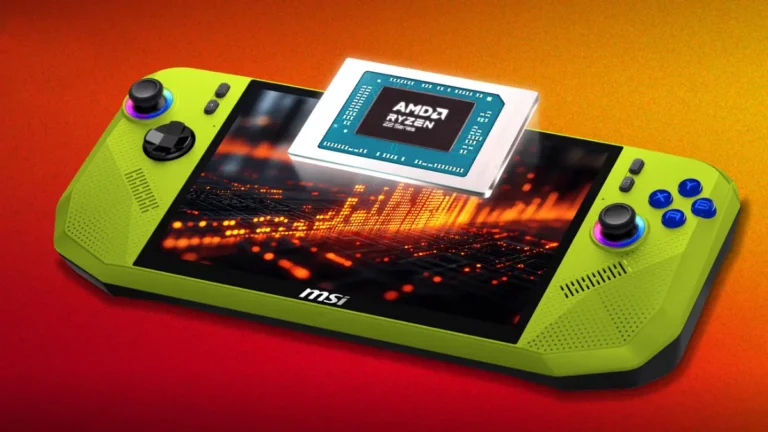
Inside you’ll find AMD’s Ryzen Z2A processor, 16GB RAM, 512GB SSD, and a 7-inch Full HD display. However, the problem is that Ryzen Z2A uses Zen 2 architecture from 2021—the same chip in the original Steam Deck. Consequently, in 2025, this is dated hardware at a premium price.
The question is simple: does the ROG Xbox Ally justify its cost, or should you look elsewhere?
ROG Xbox Ally Pricing Problem: Too Expensive for What It Offers
At $599, the ROG Xbox Ally faces brutal competition. The Ryzen Z2A processor uses four-year-old Zen 2 architecture—identical to the 2021 Steam Deck.
Here’s why the pricing fails: Steam Deck OLED costs $549 with a superior OLED display and equivalent performance. You’re paying $50 more for an inferior IPS screen and the same processing power.
The original ROG Ally with Ryzen Z1 Extreme—a significantly faster chip—sells for $649 or drops to $599 on sale. The Lenovo Legion Go with Z1 Extreme frequently hits $599 during promotions. Both deliver notably better gaming performance than the ROG Xbox Ally.
Refurbished Steam Decks cost $319-489 with similar performance at half the price.
The target customer at this price point is unclear.
Full Hardware Specs
| Specification | Details |
|---|---|
| Processor | AMD Ryzen Z2 A Zen 2 Architecture, 4 cores / 8 threads, 2.8-3.8GHz |
| Graphics | AMD Radeon RDNA 2 (8 Compute Units, up to 1800MHz) |
| RAM | 16GB LPDDR5-6400 |
| Storage | 512GB PCIe Gen 4 NVMe SSD (user-replaceable) |
| Display | 7″ Full HD IPS (1920×1080), 120Hz, VRR/FreeSync, 500 nits, 100% sRGB |
| Battery | 60Wh |
| Power Modes | Silent (13W), Performance (17W), Turbo (25W) |
| Ports | 2x USB 3.2 Gen 2 Type-C, 3.5mm audio jack, microSD card reader |
| Connectivity | Wi-Fi 6E, Bluetooth 5.2 |
| Operating System | Windows 11 with Xbox Full Screen Experience |
| Dimensions | 11.0 x 4.4 x 0.9 inches (280 x 111 x 24 mm) |
| Weight | 1.43 lbs (650g) |
| Price | $599 / £499 |
Design and Comfort: Where the ROG Xbox Ally Excels
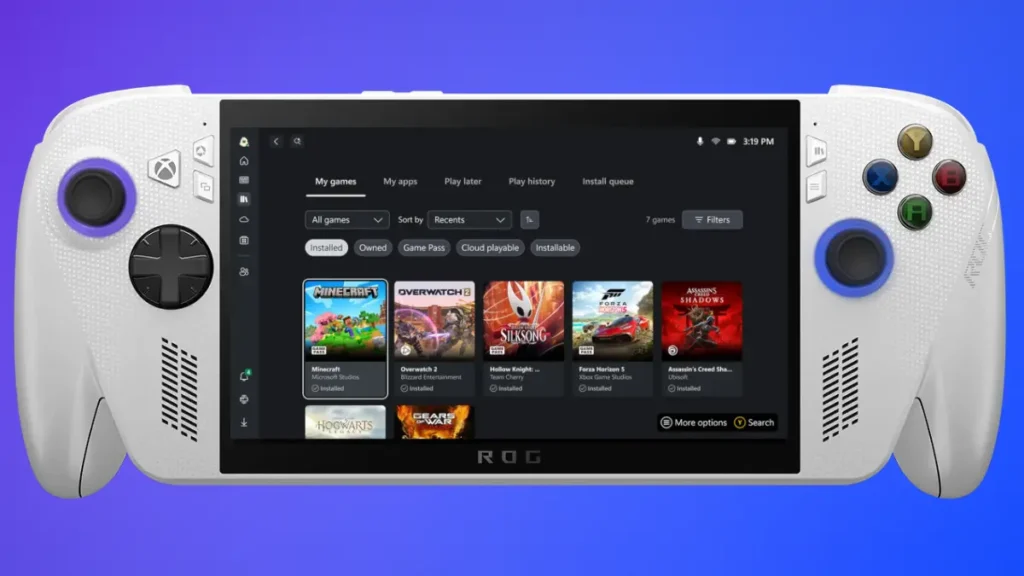
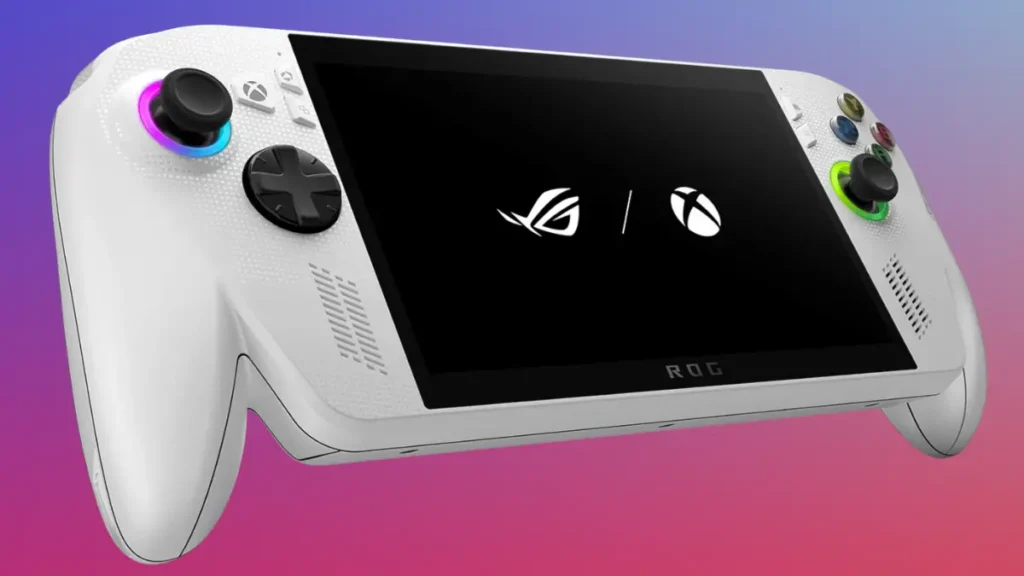
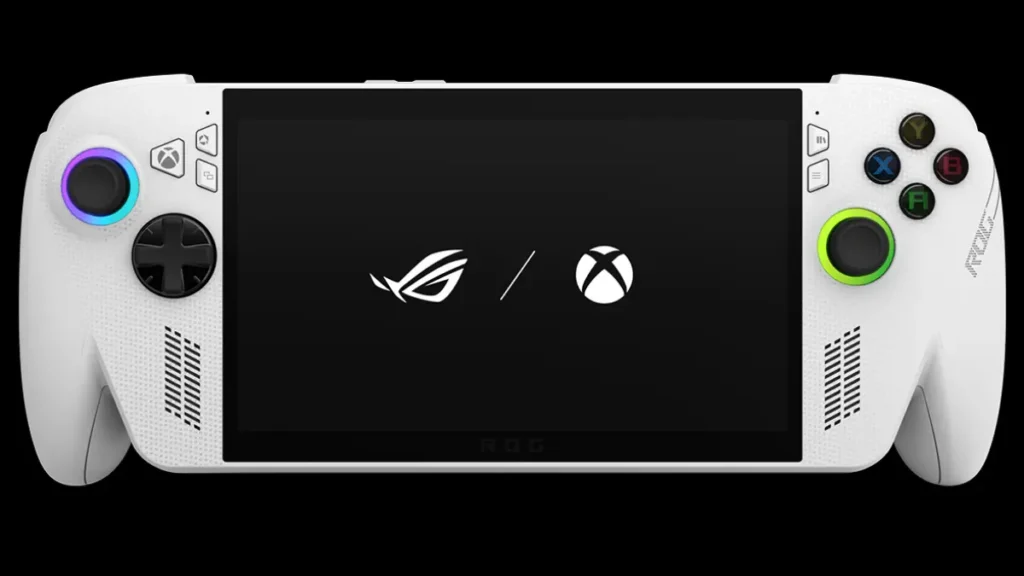
The ROG Xbox Ally nails ergonomics. Specifically, ASUS designed Xbox controller-inspired grips that make this the most comfortable handheld available. As a result, extended gaming sessions produce minimal hand fatigue—a genuine achievement.
The white finish with textured “Xbox” and “ROG” lettering provides excellent grip. Additionally, button placement is logical, with a dedicated Xbox button for quick interface access and programmable back paddles. Furthermore, face buttons are responsive, analog sticks smooth, and triggers linear.
The 7-inch Full HD IPS display runs at 120Hz with VRR support and 500 nits brightness. Colors are accurate (100% sRGB), motion is smooth. However, at $599, the lack of OLED is disappointing—especially when Steam Deck OLED costs less.
Connectivity includes two USB-C 3.2 ports, microSD slot, 3.5mm headphone jack, fingerprint sensor, Wi-Fi 6E, and Bluetooth 5.2.
The ROG Xbox Ally feels fantastic in your hands, even if the specs don’t match the price.
Gaming Performance: The Reality Check
The Ryzen Z2A (Zen 2, RDNA 2) matches Steam Deck’s 2021 APU—four cores, eight threads, 2.8-3.8GHz, with eight RDNA 2 compute units at 1800MHz. Therefore, for a 2025 device at $599, this is underwhelming.
Real-world performance:
Indie games run flawlessly at 1080p/60 FPS. Hollow Knight: Silksong, Hades II, and similar titles have zero issues.
AAA titles struggle. For example, Forza Horizon 5 manages 40 FPS at 720p low-medium settings. Meanwhile, Cyberpunk 2077 is unplayable at 1080p; at 720p low settings, expect 30 FPS. Overall, most modern AAA games require 720p resolution with low settings for 30-40 FPS.
Power modes:
- Silent (13W): Indie games, 6-8 hours battery
- Performance (17W): Balanced, 3-4 hours battery
- Turbo (25W): Maximum power when plugged in, 2-3 hours
The 60Wh battery is adequate for indie gaming but drains quickly with demanding titles.
Xbox Full Screen Experience: Best Windows Handheld Interface
The ROG Xbox Ally’s standout feature is Microsoft’s Xbox Full Screen Experience—the best Windows handheld interface yet created.
Instead of Windows desktop, the device boots into a controller-optimized interface consolidating games from Steam, Epic, GOG, Ubisoft Connect, and Battle.net into one unified library. It feels like a console dashboard, not a clunky Windows PC.
Cloud gaming via Xbox Game Pass Ultimate performs excellently. In fact, streaming at 1440p/60 FPS worked consistently with minimal stuttering. As a result, for subscribers with solid internet, cloud gaming unlocks titles the hardware can’t handle natively.
The caveat: Microsoft confirmed this interface arrives on other Windows handhelds in 2026. Legion Go 2 gets it in spring 2026. This software advantage is temporary.
Bugs still appear occasionally—failed game launches, desktop returns, inconsistent sleep mode. You’re still dealing with Windows, just with better UI.
For now, it’s the best handheld Windows experience available. That won’t last.
Who Should Buy the ROG Xbox Ally?
Finding the right customer for the ROG Xbox Ally at $599 is challenging.
Skip this if you’re:
- A serious PC gamer (Ryzen Z2A can’t handle modern AAA games well)
- An Xbox console fan (doesn’t play Xbox console games, only PC versions)
- Budget-conscious (Steam Deck OLED is $549, refurbished Steam Deck is $319-489)
Consider this if you’re:
- A cloud gaming enthusiast with Game Pass Ultimate (excellent streaming performance)
- An indie game lover who values comfort (handles indie titles perfectly)
- Someone wanting Xbox Full Screen Experience now (though it’s coming to other devices in 2026)
The ROG Xbox Ally occupies an awkward position—too expensive for what it delivers, not powerful enough to compete with alternatives.
For those seeking better performance, check out our ROG Xbox Ally X review, which features the far more powerful Ryzen Z2 Extreme processor and delivers significantly stronger gaming performance.
Final Verdict: Hard to Recommend at $599
The ROG Xbox Ally delivers excellent ergonomics, a user-friendly interface, and solid indie game performance. Indeed, the comfort level is genuinely impressive, and Xbox Full Screen Experience is the best Windows handheld UI available.
But at $599, this device struggles to justify its existence. The Ryzen Z2A offers 2021 performance in 2025, failing with modern AAA games at native resolution.
Better alternatives exist: Steam Deck OLED ($549) has a superior display with equivalent power. Similarly, the original ROG Ally with Z1 Extreme ($599 on sale) delivers stronger performance. Additionally, Legion Go frequently hits $599 with better specs. Finally, refurbished Steam Decks cost $319-489 with similar capability.
The Xbox Full Screen Experience arrives on other handhelds in spring 2026, eliminating this temporary advantage.
If you’re a Game Pass Ultimate subscriber who primarily streams games and values comfort, the ROG Xbox Ally works. If you mainly play indie titles and want the most comfortable handheld, there’s appeal.
For everyone else, wait for sales or choose alternatives. The ROG Xbox Ally is fine, but fine isn’t enough at $599.
| ROG Xbox Ally | |
|---|---|
| Overall Score | 6/10 |
| Pros |
|
| Cons |
|
Bottom Line: The ROG Xbox Ally offers comfort and decent indie gaming, but outdated hardware and poor value make it hard to recommend at full price.

Hardware. Specs. Benchmarks.
LoadMaster breaks down handheld performance to the last frame. Specializing in deep comparisons between devices like the Switch 2, Steam Deck, and ROG Ally, he focuses on specs, chipsets, battery life, and thermal behavior. If it’s measurable, he’s on it.