
While Valve’s Steam Deck revolutionized handheld PC gaming, it’s limited to a single 7-inch display. Enter Retroid’s Dual Screen Add-On – a $69 accessory that brings dual-screen gaming to handheld devices. Ironically, while Retroid doesn’t officially support Steam Deck compatibility, testing reveals it might be the best non-Retroid device for this accessory.
What Is the Retroid Dual Screen Add-On?
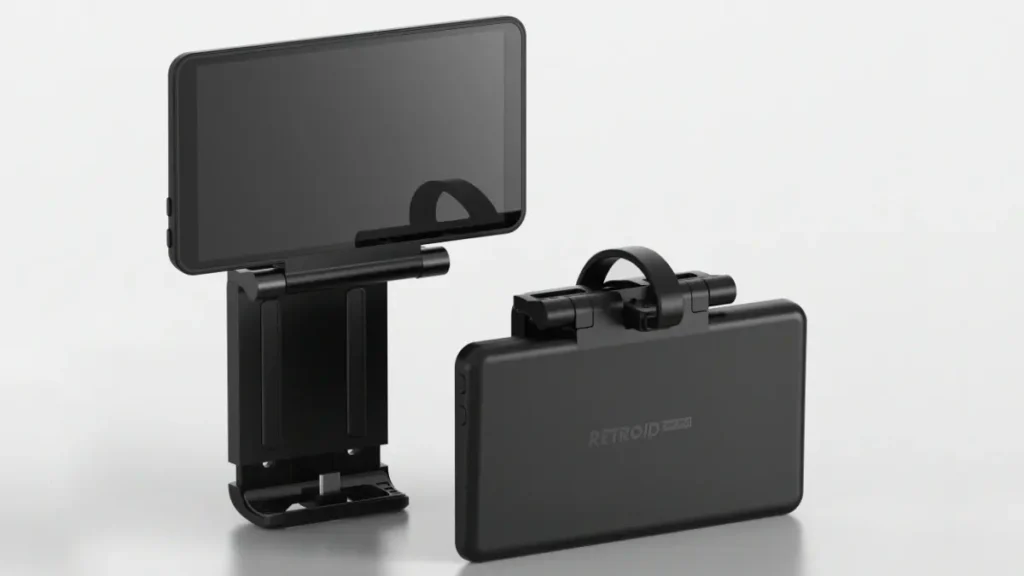
The Retroid Dual Screen Add-On features a 5.5-inch AMOLED display with 1920×1080 resolution, 500 nits brightness, and 100,000:1 contrast ratio. The touchscreen accessory connects via USB-C DisplayPort and doesn’t have a built-in battery, instead drawing power from the host device while supporting pass-through charging.
Weighing 130 grams, the add-on includes adjustable hinges that can be set to 120°, 150°, or 180° angles. It’s officially compatible with Retroid Pocket 5, Retroid Pocket Mini, Retroid Pocket Mini V2, and Retroid Pocket 4 Pro, plus any device with a 6-7 inch display supporting DisplayPort over USB-C.
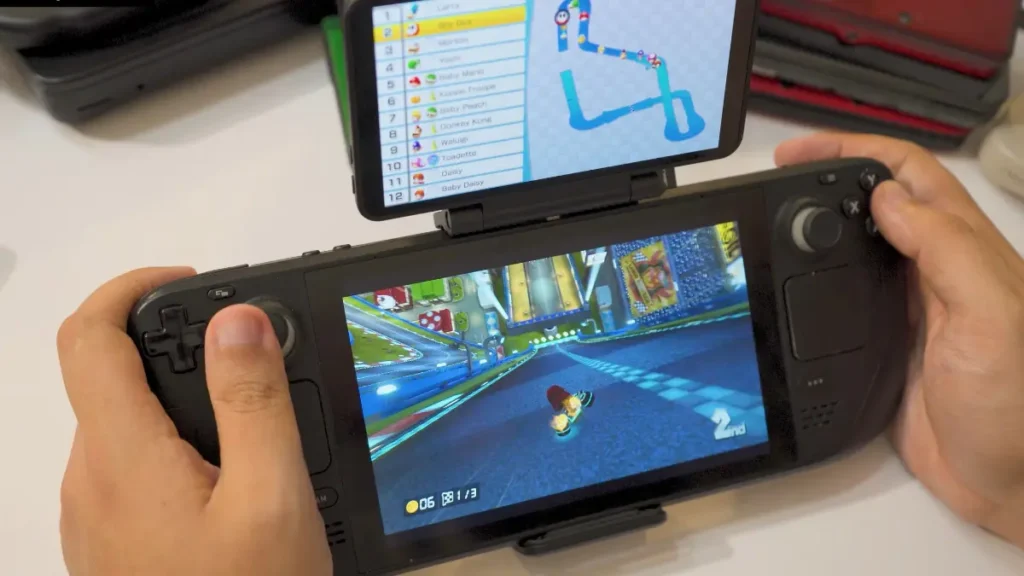
Despite Retroid explicitly stating on their website that the add-on is ‘NOT compatible with Steamdeck,’ practical testing reveals the display mounts and connects to Valve’s handheld without any issues.
GameXData Tests Steam Deck Retroid Compatibility
YouTube channel GameXData recently tested the Steam Deck Retroid combination and found surprising results. According to the YouTuber, the Steam Deck was “one of the easiest devices to pair with the display” – mounting securely and connecting without issues.
The setup proved particularly effective for emulating dual-screen systems like Nintendo DS, 3DS, and Wii U. Games such as Mario Kart benefited from having maps and item information displayed separately, while Pokémon titles worked reasonably well with the additional screen real estate.
Steam Deck Advantages Over Other Handhelds
The Steam Deck Retroid pairing offers unique advantages thanks to Valve’s trackpads. GameXData noted these helped overcome touchscreen scaling issues common in Arch Linux external displays. This makes navigation faster and more comfortable than relying on touch alone.
The combination of stable performance, the Steam Deck’s form factor, and versatile controls proved impressive. The YouTuber described it as “one of the most seamless portable dual-screen setups” tested so far.
Limitations and Compatibility Issues
Not everything works perfectly with the Steam Deck Retroid setup. Touch-heavy titles like Pokémon Ranger remain impractical, and games depending heavily on gyroscope controls can feel clumsy with the added weight and bulk.
Windows compatibility works well, suggesting the accessory could pair effectively with other handheld PCs like the ASUS ROG Ally. However, Android and iOS support remains limited, with workarounds like SF Rotate required on Android devices.
Is the Steam Deck Retroid Combo Worth It?
At $69, the Retroid Dual Screen Add-On offers an affordable alternative to purpose-built dual-screen handhelds that cost over $1,000. For Steam Deck owners interested in DS, 3DS, or Wii U emulation, this unofficial pairing provides genuine value.
The irony that Retroid’s “unsupported” device might be the best non-Retroid handheld for their display makes this combination even more intriguing for handheld gaming enthusiasts seeking dual-screen capabilities without breaking the bank.
Looking for more Steam Deck enhancements? Check out how FSR 4 can dramatically improve your gaming visuals through software optimization.

Hardware. Specs. Benchmarks.
LoadMaster breaks down handheld performance to the last frame. Specializing in deep comparisons between devices like the Switch 2, Steam Deck, and ROG Ally, he focuses on specs, chipsets, battery life, and thermal behavior. If it’s measurable, he’s on it.